
Registered Pest Control Operator · Reg. No. P54412 · 30+ years, second-generation technician
The rain spider is the single most alarming-looking creature that comes into a South African home, and after thirty years I still have not been called to one that was genuinely dangerous.
Let’s talk about it.
What You’re Actually Looking At
The one you’re most likely to meet is the common rain spider, Palystes superciliosus, and it carries a piece of local history in its old name. It was originally described as Palystes natalius, after Natal. The spider on your ceiling in Durban is, in a manner of speaking, the original one.
Here is what to look for:
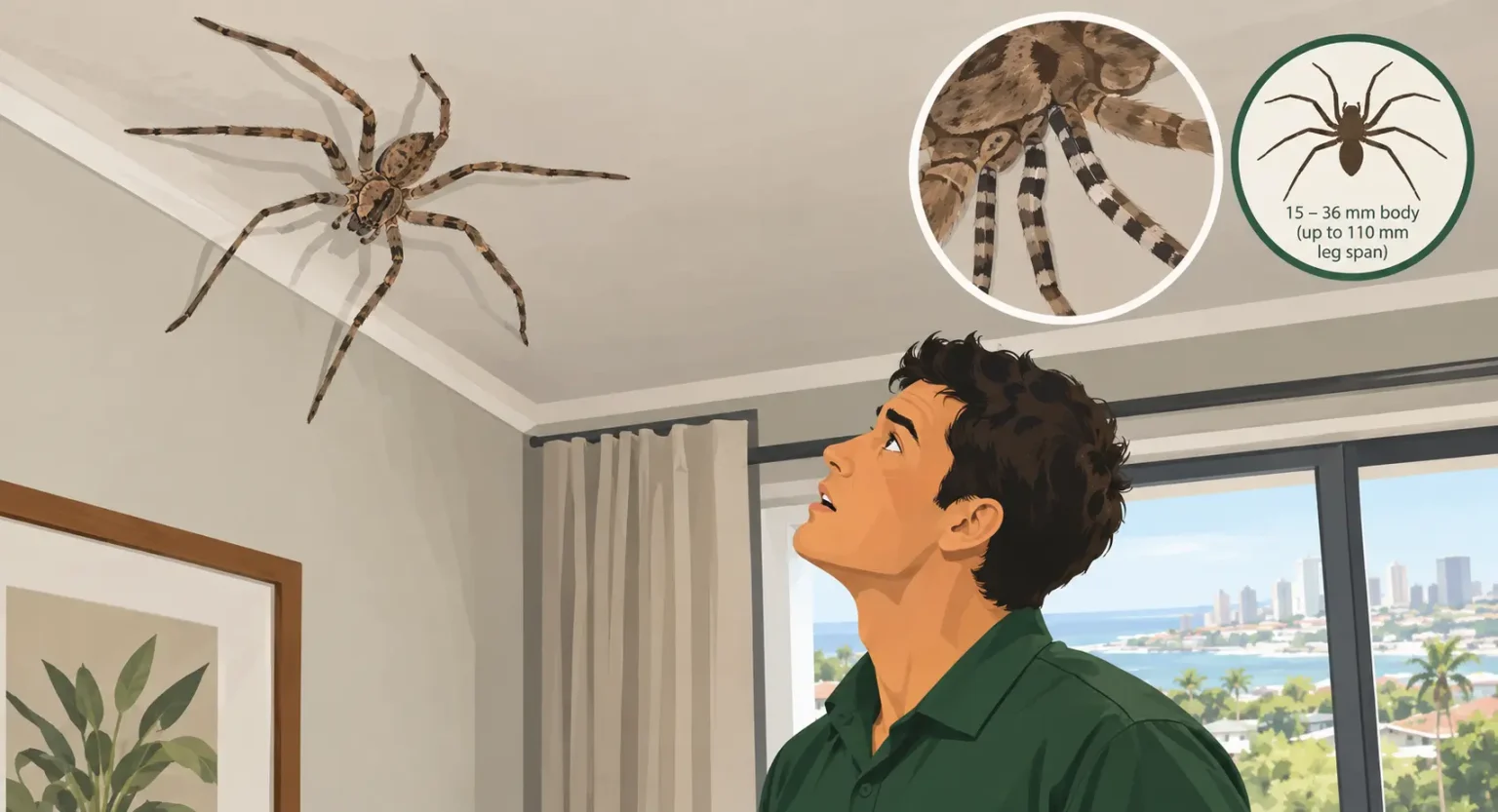
- A body between 15 and 36 mm, with a leg span reaching up to 110 mm. That is genuinely palm-sized on a mature female.
- Brown or grey-brown overall, with distinct black and white banding on the underside of the legs. When one is sitting on your ceiling you’re looking straight at that banding, and it’s the quickest way to be sure.
- Long, thin legs held out flat and sideways rather than tucked underneath. Baboon spiders are thick-legged and squat, and they don’t climb your walls.
- No web anywhere near it. Rain spiders don’t spin one to catch anything. They run their prey down at night.
People ask me constantly whether a rain spider and a huntsman spider are two different things. They’re the same family, Sparassidae. “Huntsman” is the international name, “rain spider” is what we call our local Palystes species in Southern Africa. When you search huntsman spider South Africa, this is the animal you land on.
One more thing worth knowing, because it explains a lot about where you find them: they hunt insects, and they also take small geckos. That gecko living behind your outside light is on the menu.
Why They Come Indoors Before Rain
The common name is accurate. These spiders commonly move into houses ahead of rain, and generally through the summer months.
Along our coast that means from roughly October onwards, when the afternoon build-ups start rolling in off the warm water and we get those short, heavy KZN storms two or three times a week. A dry roof void, a garage, a curtain fold, the top corner of a bedroom ceiling. All of it is better shelter than a shrub in the garden with 30 mm of rain coming down on it.
Shelter is only half of it though. The other half is dinner.
Your outside lights pull in moths and flying insects all evening. The geckos come for the insects. The rain spider comes for both. In older suburbs like Berea, Morningside, Glenwood and the leafier parts of Westville and Kloof, where gardens are mature and homes have gaps under doors and around older window frames that a spider can walk straight through, this happens every single summer to the same houses.
I want to be clear about something: a rain spider in your lounge says nothing about how clean your house is. It says your garden is alive and your lights are on.
Getting One Out Without Anyone Getting Bitten
Let me deal with the poison question first, because nobody can think about anything else until it’s answered.
A rain spider bite is medically insignificant. The reference literature puts it on a par with a bee sting: a burning sensation and localised swelling that lasts a few days, with full recovery on its own and no treatment required. The African Snakebite Institute describes it as painful at first and then itchy, settling within hours. There is no cytotoxic damage, no antivenom, no complication to watch for.
They’re also remarkably reluctant to use it. Rain spiders are docile animals that would far rather run than fight, and in three decades I’ve only ever read of two circumstances where somebody got bitten: they grabbed it in their hand, or they went near a female guarding her nest.
So, the method that works:
- Get a large jar or an ice-cream tub and a sheet of stiff paper or thin card. It needs to be big. Trapping half a leg is how you end up with a stressed spider.
- Place the container over the spider in one steady movement, then slide the card slowly underneath until it’s sealed.
- Carry it out and release it into a shrub or against a wall well away from your doors. It will be gone by morning.
- Then switch off the outside light nearest that door for a few nights and check the gap under it. You’re removing the reason it came in.
What I’d ask you not to do is reach for a can of fly spray while it’s on the ceiling. It won’t kill it quickly, it will drop somewhere you can’t see, and you’ve now got an agitated spider loose on the floor plus a residue on your ceiling doing nothing useful for anybody.
Hitting it is worse. If it’s a female carrying an egg sac, you’ve just turned one spider into a considerably bigger job.
Seeing them week after week rather than once a season? That’s usually a sign something else in the house is feeding them. See how our Spider Control works.
Get in Touch →The Ball of Leaves in Your Garden
Most people find the nest before they ever find the spider. It’s an untidy ball of leaves and twigs bound together with silk, sitting in a shrub about waist height, and it looks like something a bird abandoned.
That’s the egg sac. She builds it between 60 and 100 mm across, over three to five hours, weaving the surrounding leaves straight into the silk so it sits camouflaged in the plant. Then she stations herself on it and guards it, properly aggressively, until the spiderlings hatch inside and chew their way out about three weeks later. A female builds around three of these across a two-year life.
This is the one situation where a rain spider will genuinely come at you, and it’s worth respecting. She isn’t being aggressive at you personally. She’s sitting on everything she’s got.
My advice is to leave it where it is. Three weeks and it’s over, and the spiderlings disperse into the garden rather than into your house. If it’s somewhere genuinely impractical, like a shrub right against the back door where children run past, prune the branch it’s attached to and move the whole branch rather than going anywhere near the sac itself.
There’s a postscript to this that I find fascinating and that almost nobody knows about. If you ever see a large, brilliantly coloured wasp dragging a rain spider backwards across your paving, stop and watch it. That’s Tachypompilus ignitus, a pompilid wasp that specialises almost entirely in hunting mature female Palystes. It paralyses her with a sting, hauls her to its nest, and lays a single egg on her body. The larva then eats her slowly, taking the peripheral flesh first and leaving the vital organs for last so she stays alive as long as possible.
Whatever you feel about rain spiders, they have it harder than you do.
When You Actually Need Pest Control
I’ll be straight with you, because I’d rather say this than take the callout: one rain spider in October doesn’t need a pest control operator. It needs a jar and two minutes.
Here’s where it changes.
- You’re finding several a week, in the same rooms, month after month. Rain spiders are predators. A house producing a steady supply of them is producing a steady supply of something for them to eat first, usually moths and flying insects at the lights, sometimes cockroaches in the kitchen. Treat the spider and they come back. Treat what’s feeding them and they leave on their own.
- You’re finding egg sacs regularly around the house and garage. Occasional sacs in the garden are normal. Repeated sacs in a garage or store room mean they’re breeding on the property rather than passing through.
- You run a guesthouse, a restaurant, or a school. Different standard entirely. Guests and parents don’t weigh up the medical facts, and you need documented control rather than a jar.
What a proper job looks like in that situation is an inspection of the entry points and the prey population first, then targeted residual treatment at those entry points, and a follow-up. You can read more about how we approach spider control on Durban homes, and if you want the broader picture of what we do across the city, that’s all set out on our pest control in Durban page.
One medical note to close this section. If somebody has been bitten and the swelling hasn’t started settling after a few days, or there’s spreading redness or fever, that’s a doctor rather than a pest control operator. That reaction isn’t typical of a rain spider and it’s worth having looked at properly.
The Bottom Line
The rain spider is the most frightening-looking and least harmful thing that will walk into your house this summer. It eats the insects you actually don’t want, it leaves on its own, and its bite is a bad afternoon rather than an emergency.
What’s worth paying attention to is frequency. Once or twice between October and March is Durban working exactly as Durban works. Every few days, in the same rooms, year on year, is the house telling you something about what else is living in it.
If you’re standing in your kitchen right now not sure what you’re looking at, take a photo and send it through. I can almost always tell you inside a minute whether it’s a rain spider or something that deserves more attention, and it costs you nothing to ask.
Thank you, and God bless.
Mark Abraham
Registered Pest Control Operator · Reg. No. P54412 · Structural Pest Control (Commercial & Domestic), Dept. of Agriculture, Act 36 of 1947
Frequently Asked Questions (FAQs)
Are rain spiders in South Africa poisonous?
No. A rain spider bite is medically insignificant and comparable to a bee sting, causing a burning sensation and localised swelling that clears on its own within a few days. There is no antivenom because none is needed. They are also very reluctant to bite, and almost every recorded bite involves either handling the spider directly or disturbing a female guarding her egg sac.
What attracts rain spiders into the house?
Shelter and food. They move indoors ahead of rain and through the summer months, and they follow prey. Outside lights draw moths and flying insects, geckos arrive to feed on those insects, and rain spiders hunt both. Gaps under doors and around older window frames give them the way in.
Is a huntsman spider the same as a rain spider?
Effectively yes. Rain spiders belong to the family Sparassidae, which is the huntsman spider family. Huntsman is the international name for the family, while rain spider is the Southern African common name for our local Palystes species, most often Palystes superciliosus.
How do I get rid of a rain spider in my house?
Place a large jar or tub over it, slide a sheet of stiff card underneath, and release it into a shrub away from your doors. Avoid using fly spray while it is on the ceiling, as it will not work quickly and you will simply lose track of the spider on the floor. Switching off the nearest outside light for a few nights removes the insects that drew it in.
What is the ball of leaves and silk in my garden?
That is a rain spider egg sac. The female builds it 60 to 100 mm across over three to five hours, weaving surrounding leaves and twigs into the silk, then guards it aggressively until the spiderlings chew their way out roughly three weeks later. Leaving it undisturbed is usually the best approach, since the spiderlings disperse into the garden rather than into the house.
How big do rain spiders get?
Body length runs between 15 and 36 mm, with a leg span reaching up to 110 mm on a mature female, which is roughly the size of an adult hand. The long, thin legs and the black and white banding on their undersides separate them from thicker-legged spiders such as baboon spiders.