Termite or wood borer? Find out in ninety seconds.
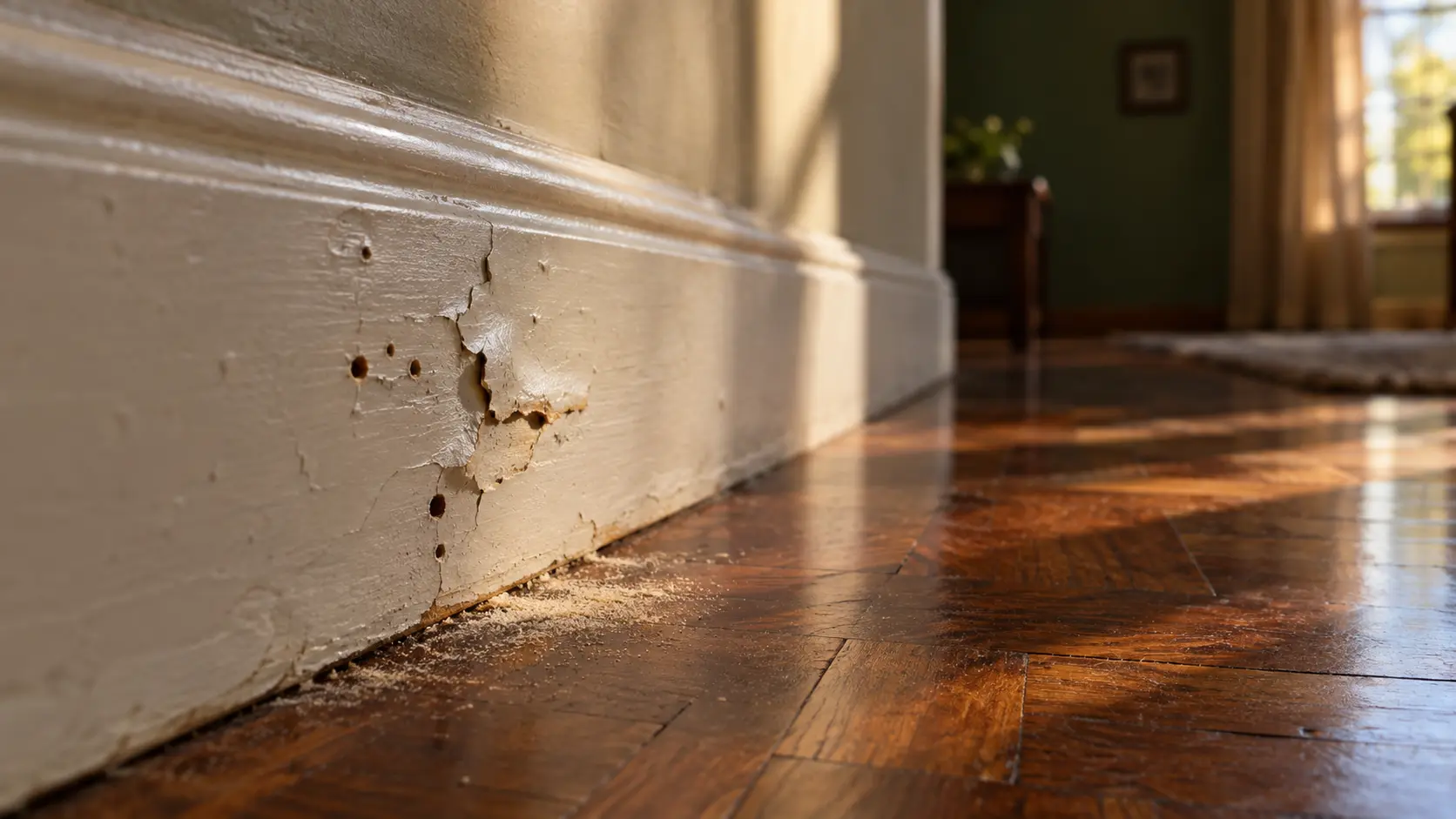
Holes in the skirting, dust under the ceiling, something that sounds hollow when you tap it. Answer a few questions about what you can actually see and we’ll tell you what it most likely is, how bad it looks, and what to do next.
Duguza Pest Control has been treating termites and wood borer across greater Durban since the early nineties. Inspections are free, and we issue documented certificates for resale and compliance.
What the signs actually mean
Most people only find one clue and then guess from there. The trouble is that a single sign rarely settles it. Here is what each one is really telling you, and which way it points.
Dust that collapses into powderPinch it. If it crushes into something like flour or talc, you are looking at beetle bore dust. Pale, soft and shapeless, with no grain structure to it at all.
Grit that rolls like sandHard little grains that roll between your fingers rather than crushing are drywood termite pellets. They are about a millimetre long, six-sided, and often several shades of brown in one pile.
A neat cone under a holeDrywood termites open a hole, push their waste out, then seal it again. That leaves a tidy cone directly below, like tipped-out pepper. Beetle dust scatters instead of piling up neatly.
Soil packed inside the woodEmpty tunnels point to a beetle. Tunnels stuffed with damp soil point to subterranean termites, which carry the ground in with them as they go.
A single mud tube up a wallOne narrow tube, about pencil width, running from soil level up onto the building. That is a covered runway. Several tubes bunched together under an overhang is a mud dauber wasp, which is harmless.
The edge of the holeThis one decides whether it is live. A fresh hole has a sharp rim with pale timber just inside. An old one is darkened and softened, often with a cobweb across it. Holes stay visible for decades after the cause has gone.
Shed wings on a window sillWorth taking seriously. Colonies only produce flying reproductives once they are mature, which often means five years or more already established somewhere nearby.
A screwdriver that sinks inTry it on a hidden section first, since it leaves a mark. If the blade goes in thirty millimetres with no resistance, that timber has lost real strength and the guessing stops being useful.
Termites vs wood borer, side by side
The two get mixed up constantly, and the treatment is not the same. Here is how they separate on the things you can actually check yourself.
| What you check | Wood borer beetle | Drywood termite | Subterranean termite |
|---|---|---|---|
| The debris | Fine powder. Collapses when pinched, like flour. | Hard six-sided pellets about 1mm. Roll between your fingers like sand. | Damp soil, carried in and packed into the galleries. |
| How it sits | Scattered loosely below the holes, or caked in crevices. | Neat cone-shaped piles directly under a hole. | Inside the timber rather than on the floor. |
| The holes | Round, 1 to 2mm, clean-cut and open. Bigger and oval for longhorn species. | Round, 1 to 2mm, often plugged flush with a pale wood-pulp seal. | Usually no holes at all. Mud tubes and soil sheeting instead. |
| The galleries | Empty, or loosely packed with powder. Run with the grain. | Clean chambers with a smooth finish. No soil. | Lined and packed with soil. Will cross the grain. |
| Needs soil contact | No. | No. The whole colony lives sealed inside the timber. | Yes. The nest sits in the ground and the workers commute. |
| The insect | Small brown beetle, 3 to 7mm, head tucked under a hood. Creamy C-shaped grubs inside. | Pale soft-bodied, no pinched waist. Straight antennae on the flyers. | Same pale soft body. Soldiers have a larger dark head. |
| When you see them | Adults emerge roughly September to February. | Flights October to March, on warm humid evenings. | Flights October to March, a few days after good rain. |
| How it gets in | Adults lay eggs in the timber surface. Often arrives in furniture or new timber. | Flyers land and start a colony inside the wood. Travels in furniture. | From the soil, through slab edges, cracks and pipe openings. |
| Typical treatment | Drill and inject for localised work, fumigation where it has spread. | Fumigation or heat, because the colony is sealed inside the timber. | Soil treatment or baiting, because the nest is outside the building. |
On a phone, swipe the table sideways to see all four columns.
Why Durban is its own case
Most of the wood borer advice you’ll find on South African sites was written for Cape Town, or lifted wholesale from the UK. Here is what is actually true for the KwaZulu-Natal coast.
- Our climate does the work for themWarm, humid and coastal is close to ideal for both drywood termites and borer beetles. The Durban coastal strip carries noticeably more wood-destroying insect pressure than the interior does.
- This is drywood termite countryCryptotermes has been recorded in Durban since well before the war, and the coastal KZN belt is where it lives. Plenty of local content still only mentions subterranean termites, which misses half the problem.
- The Cape borers are not our borersThe house longhorn beetle and the brown house borer get named constantly in South African articles. Both are Cape species. The ones with actual Durban and Zululand records are the common furniture beetle, the powderpost beetle and the bamboo borer.
- Cane and bamboo furniture has its own pestThe bamboo borer has been recorded in Durban since 1917 and is described as distributed throughout the old Natal and up the east coast. If you have cane or wicker, it is worth checking.
- Swarming season runs October to MarchNot April to September, which is what a lot of copied content says. That is the Northern Hemisphere flight season. Here the flyers come out on warm humid evenings in summer, usually a few days after good rain.
- Certificates work differently hereA beetle or wood borer certificate is a contractual requirement written into a sale agreement rather than a legal one, and the convention is far stronger in the Western Cape than it is in KZN. Your agreement decides whether you need it. Banks sometimes ask independently for a bond.
What happens if you book
We come and look
Roof space, subfloor, skirtings, frames and any furniture you’re worried about.
You get it in writing
What we found, where, whether it is active, and what we would do about it. If you need a certificate for a sale or a bond, we’ll tell you what is involved.
You decide
Drill and inject, fumigation, soil treatment or baiting, depending on what is actually in there. We’ll quote it and we’ll beat any comparable written quote.
Don’t wait for the checker. Send us a photo on WhatsApp and we’ll tell you straight away whether it needs someone out today.
Frequently Asked Questions (FAQs)
How accurate is this checker?
It is a guide, not a diagnosis, and it will say so at the end. It works from the signs you can see from the outside, and the inside of a piece of timber is always further along than the surface suggests. What it does well is narrow the field and tell you how urgent the situation looks, which is usually the thing people actually want to know before they pick up the phone.
Anything involving a roof structure or a floor gets confirmed on site. That is not us being cautious for the sake of it. It is that nobody can call it properly without getting into the roof and under the floor.
Can I have termites and wood borer at the same time?
Yes, and it happens more than people expect. They eat different things in different ways and they arrive by different routes, so one does not exclude the other. If you have picked both a mud tube and flour-fine powder, the checker will tell you it looks like two separate problems rather than forcing a winner.
How do I know whether the damage is old or still active?
Clean the area completely, tape white paper underneath, write the date on it, and circle two or three existing holes in pencil. Leave it a week. Fresh dust on the paper, or a new hole that is not circled, means something is still alive in there. A clean sheet points to old damage.
This is the single most useful thing you can do before calling anyone, and it costs nothing. Exit holes stay visible for decades, which is why old damage worries people long after the cause has left.
What are those tiny holes with blue-grey staining around them?
That is pinhole or ambrosia borer damage, and it happened before the timber was ever sawn. Those beetles attack living or freshly felled trees, and the dark stain comes from a fungus they carry with them. Once the wood is dried and installed they are long gone and they will not come back. It is cosmetic, and it needs no treatment.
There’s one big round hole in my pergola beam. Is that termites?
Almost certainly a carpenter bee. They bore a single, very clean, perfectly round hole about pencil width, which then turns sharply once it’s inside. They nest alone rather than in colonies, so you get one or two holes instead of a scatter. Years of repeat nesting in the same beam can weaken it, but this is not an infestation and it will not spread into your house.
Do I need a beetle certificate to sell my house in Durban?
It depends on your sale agreement rather than on the law. A beetle or wood borer certificate is a contractual requirement written into the contract of sale, not a statutory one, and the convention is considerably stronger in the Western Cape than it is here. Banks sometimes ask for one independently as a condition of the bond.
Worth knowing either way: a seller who is aware of an infestation and stays quiet about it can still be held liable, even where there is a voetstoots clause. An inspector has to be registered with the South African Pest Control Association for the certificate to be worth anything.
When do flying termites swarm in Durban?
October to March, peaking around November to January, on warm humid evenings a few days after good rain. Wood borer beetles emerge over a similar window, roughly September to February.
If you read April to September anywhere, that is copied Northern Hemisphere content and it is the opposite of our season.
Can I just treat it myself with something from the hardware store?
Surface sprays sit on the surface, and the problem is several centimetres inside the timber. For a single piece of furniture with light borer activity you may get somewhere. For roof trusses, floors or anything that has spread, you are mostly buying time and hiding the evidence.
One thing to avoid regardless: do not fill, seal or paint over the holes before someone has looked. It makes proper identification much harder and it does nothing to what is inside.
Still not sure? That’s what an inspection is for.
We’ll get into the roof, check the subfloor, and tell you plainly what is in there and what it needs. No charge for the look, and we’ll beat any comparable written quote.