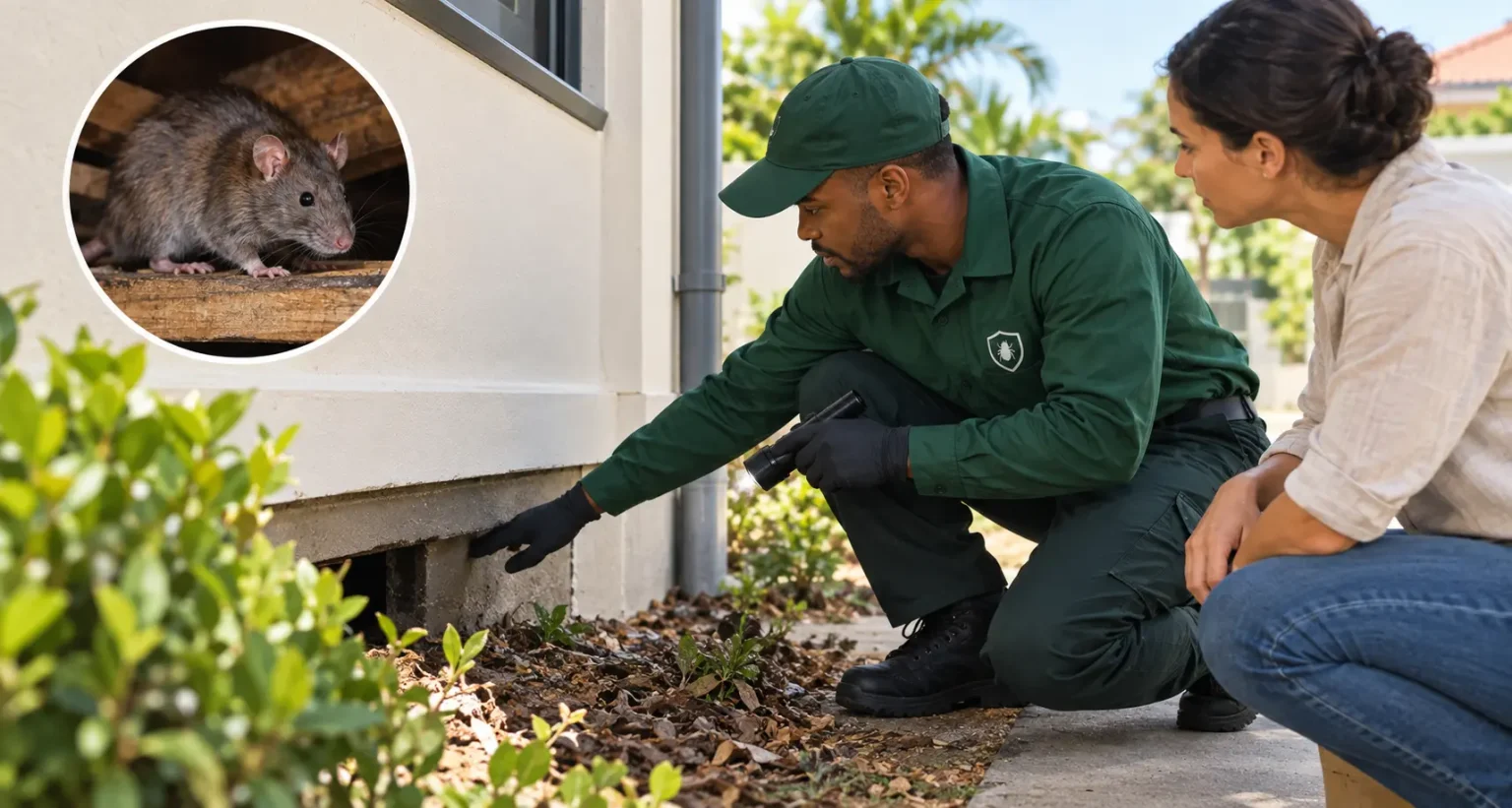

Registered Pest Control Operator · Reg. No. P54412 · 30+ years, second-generation technician
Rats never move into a home by accident. Something inside it, or just outside it, is giving them food, water or somewhere warm and dark to nest, and in Durban’s warm, humid climate they never really have an off-season. That’s what makes them worth understanding properly, not just reacting to.
Most people only find out when something wakes them up at night. If that’s what brought you here, start with our article on what scratching noises in your Durban home mean. If you already know it’s rats, this article covers what you can do yourself, why the shop-bought route so often fails, and when it’s time to call someone.
Rather have it handled for you? WhatsApp Mark or call 064 527 6227.
Which Rats Are You Dealing With (And How to Tell)
Two species cause most of the trouble in and around Durban homes, the roof rat and the Norway rat, with house mice adding to the problem. Knowing which one you have tells you where to look, and where the nest is most likely to be.
Roof rats. These are the ones most Durban homeowners end up dealing with. They’re smaller and sleeker, with a tail longer than their body, and they climb extremely well. They nest above the ground, in roof voids, ceilings, palm trees and thick creepers, so if you’re hearing things overhead at night, this is usually who it is.
Norway rats. These are bigger and heavier, with a shorter tail. They stay at ground level, nesting in burrows under sheds and slabs, along drains and near refuse.
House mice. Much smaller, and their droppings are a fraction of the size of a rat’s. The signs overlap, but it’s a slightly different job.
The quickest way to tell rats from mice is the droppings and the gnaw marks. Rat droppings are noticeably larger, and rat gnawing is far more obvious. Other signs to look for:
- Scratching, scurrying or squeaking in the ceiling or walls, mostly at night
- Greasy rub marks along walls and beams, where they run the same route every night
- Shredded insulation, paper or fabric that’s been pulled together for a nest
- Gnawed food packaging, cables or pipes
- Droppings in the roof space, cupboards, garages or along walls
If you’re seeing more than one of these, it’s worth taking seriously. Rats rarely arrive alone, and they breed quickly.
Why Rats Move Into Durban Homes (And Why They Stay)
Rats need three things: food, water and shelter. Take those away and there’s little reason to stay, but in a lot of Durban homes, at least one of them is being provided without anyone realising.
Food. Open bins, pet food left out overnight, fallen fruit from mango and avocado trees, compost heaps and bird seed. Rats aren’t fussy, and they’ll go for the easiest meal on the street.
Water. Leaking taps and pipes, pet bowls, blocked gutters and pooling water after summer rain. Just like with cockroaches, our humid coastal climate gives them more than they need.
Shelter. Overgrown vegetation against the walls, palm trees and creepers touching the roof, cluttered garages and storerooms, and roof voids that nobody has been into for years. Branches that touch the roof deserve special attention, because they give roof rats a bridge straight onto it.
As for how they get in, mice can squeeze through a gap about as wide as a pencil, and young rats through one only slightly wider. Common routes are around pipes and cables, damaged eaves and fascia, broken air bricks and gaps under doors. It’s why a home that looks perfectly sound from the outside can still have rats in the roof.
What You Can Do Yourself (And Where It Stops)
I’ll be upfront with you here: there’s plenty you can do to make your home less attractive to rats, but getting rid of a colony that’s already settled in your roof is a different matter. What follows is mostly prevention, and it’s worth doing whether you end up calling us or not.
- Remove what’s feeding them. Use bins with lids, take pet food away at night, pick up fallen fruit and fix leaking taps and pipes.
- Cut trees and creepers back from the roof. Roughly a metre is a good rule, so roof rats can’t use branches as a bridge.
- Clear the clutter. Garages, storerooms and the space around the house give rats somewhere to hide and nest. The less cover there is, the less appealing it becomes.
- Set snap traps along the walls. Rats prefer to run along edges. Be patient, because they’re wary of anything new and can ignore a trap for days.
- Check for fresh signs. New droppings, fresh gnaw marks or noises at night tell you whether what you’re doing is working.
What none of this does is deal with a nest that’s already established in a roof void or wall cavity, and in most homes that’s where the problem sits. That needs a different approach, ideally through a proper rat and rodent control treatment.
Tried the DIY route and still hearing them at night? Rats in a roof rarely go away until the nest has been found and treated. See how our Rat and Rodent Control works.
Why Poison Alone So Often Fails
Shop-bought poison is the first thing most people try, and it’s the reason a lot of people end up calling us a few weeks later. It’s not that poison never works. It’s that on its own, it usually fails for a handful of reasons.
- Rats are suspicious. They avoid anything unfamiliar, so they can ignore fresh bait for days, and by the time they do touch it the problem has usually grown.
- It’s in the wrong place. Bait scattered where you can reach it isn’t where they nest, and in most homes that’s the roof void or a wall cavity.
- They die where you can’t reach them. A rat that eats poison in the roof can die in the ceiling or a wall cavity, and you’ll smell it for a while.
- It can harm other animals. Pets, and birds of prey like owls, can be poisoned by eating a rat that has taken bait.
- Nothing has changed. If the food, water and shelter that drew them in are still there, new rats simply move in, and they breed quickly. Roof rats can have several litters a year, with up to eight young in each.
That’s why a rat problem in the roof rarely goes away with a box of poison from the shop. It takes finding where they’re nesting and treating it in the right place, which is exactly what our rat and rodent control is built around.
What Professional Rat Control Involves (And How Long It Takes)
It starts with an inspection, not a product. Here’s how our rodent control works.
- Inspection. We check the roof space, wall cavities, garden and entry points to work out which species you have and how far it has spread.
- Targeted treatment. Baiting and trapping are focused on the nesting areas and the routes they use, not scattered around the house.
- Registered products. They’re placed strategically, with your children and pets in mind. Just tell us who lives at the property.
- Prevention. We point out the entry points and food sources to deal with so they don’t return.
You should see a clear drop in activity within the first one to two weeks. Rats already in the roof don’t all leave on the same day, so you may still hear the odd noise at first, and if one dies somewhere you can’t reach, there can be a smell for a while. It passes.
One practical note: rats can carry diseases, so wear gloves when you clean up droppings and don’t sweep them dry. Dampen them with disinfectant first and wipe them up, instead of stirring the dust into the air. And what decides whether they come back is the food, water and shelter around your home, which is why the prevention steps above still matter after a treatment.
Rats in the ceiling tonight? Our emergency pest control line can get someone out the same day, and if the problem runs across a whole complex, see our body corporate pest control.
Getting Rid of Rats in Durban: The Short Answer
There’s no single trick that gets rid of rats in a Durban home.
It takes a combination: remove what’s attracting them, and treat the nest itself, in the right place, by someone who knows what to look for. You can do the first part yourself. The second is where a registered operator is worth calling in.
If you’re not sure what you’re dealing with, send us a photo of the droppings or the gnaw marks, or give us a call. And if you’re wondering what it will cost, we’ve written about what drives the price of rat control in Durban.
Thank you, and God bless.
Mark Abraham
Registered Pest Control Operator · Reg. No. P54412 · Structural Pest Control (Commercial & Domestic), Dept. of Agriculture, Act 36 of 1947
Hearing scratching in the ceiling or finding droppings? Don’t wait for it to get worse. Find out about rat and rodent control in Durban.
Frequently Asked Questions (FAQs)
Can I get rid of rats with poison from the shop?
It may kill some, but it rarely solves the problem. Rats avoid unfamiliar bait, poison put where you can reach it isn’t where they nest, and dead rats in the ceiling or a risk to pets and birds of prey can follow. Sort out the food and water first, and call a professional if the rats are in the roof.
How do I know if it’s rats or just mice?
Look at the droppings and gnaw marks. Rat droppings are larger than mouse droppings, and rat gnaw marks are more obvious. Noises in the roof at night usually point to rats.
Are rats in the roof a serious problem?
Yes. They can chew through wiring and insulation, which is a fire risk, and they leave droppings and urine in the roof space. The longer they’re there, the more of them there tend to be.
Is rat control safe for children and pets?
We use registered products, placed strategically with children and pets in mind. Tell us who lives at the property when you book so we can plan around them.
How long does it take to get rid of rats, and will they come back?
You should see a clear drop in activity within the first one to two weeks. They can return if the food, water and shelter around your home stay the same, and sealing entry points and removing food sources is what stops them coming back.
You Might Also Like

Rat Control Cost in Durban: What Drives the Price
What affects the price of rat and rodent control, and what a proper quote includes.

What Do Scratching Noises in Your Durban Home Mean?
What is really going on when you hear it at night.
How to Get Rid of Cockroaches in Durban
Why they won’t leave, and what works.